
BANT is a sales qualification framework: Budget, Authority, Need, and Timeline. It's used to determine whether a prospect is worth pursuing further. It works best as a natural conversation, not a checklist to interrogate prospects with.
BANT was developed by IBM in the 1950s as a way to identify opportunities that matched their criteria for routing deals to the right teams, reps, and pipelines. It's been used successfully by sales organizations worldwide ever since.
What Does BANT Stand For?
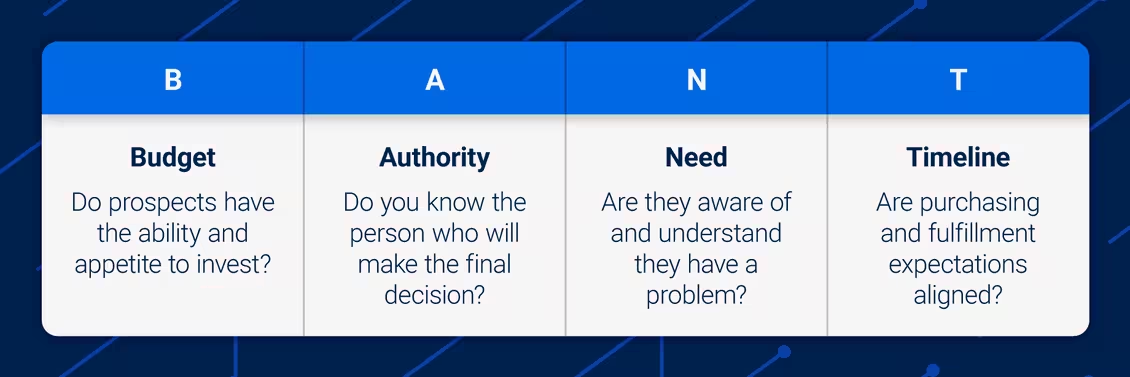
- Budget: can the prospect afford your solution, now or soon?
- Authority: is this person able to drive the deal to a decision?
- Need: do they have a real, acknowledged problem to solve?
- Timeline: when do they need a solution in place?
Each of these high-level categories branches into its own decision tree of questions to determine whether or not a lead is qualified.
What Does BANT Mean in Sales?
In sales, BANT means using those four criteria as a lens for deciding whether a lead deserves more of a rep's time: not as a rigid script, but as a way to confirm that budget, decision-making power, real need, and urgency have all been addressed before a deal moves further into the pipeline.
BANT Sales Qualification Methodology
BANT is a sales qualification methodology that provides a basic framework for reps to ask prospects questions that help answer the ultimate question: Is this a sales qualified lead? Qualification and forecasting aren't separate problems: a deal that skipped BANT is a deal riding on the weakest forecasting method there is, a rep's gut feel. See how the six common forecasting methods compare and where qualified deal data actually fits.
The goal of BANT is not to provide an interrogation-style template for qualifying leads, but instead to provide high-level guidance on the information that would ideally be extracted from a natural conversation.
In practice, most reps work through the four pillars in roughly this order:
- Confirm need first. Before anything else, establish that the prospect has a real, acknowledged problem you can solve.
- Test budget early, gently. Get a directional sense of budget without anchoring a number too soon.
- Map authority. Identify who else needs to sign off, and whether your contact can get you there, or can connect you to someone who can. See how sales leaders approach opportunity qualification.
- Pin down timeline. Understand what's driving urgency (or the lack of it) so you can set realistic next steps.
When a new lead enters the purview of your SDR or BDR, they are essentially a blip on the radar with no information other than their existence. Each of the four pillars of BANT helps fill in the blanks and move them closer to the target of sales-qualified.
Reps rarely do this consistently by hand across a full pipeline. Backstory's opportunity qualification tools score every deal against BANT (or MEDDPICC, SPICED, or your own framework) automatically, pulled from the calls and emails where the answers actually got said.
Budget
We would argue the BANT acronym is in order of importance, with the "B" for budget being the most important qualifying question: Do they have the budget?
When vetting an SQL, it's essential to get a firm grasp on whether they have, or will have, the budget to match your pricing and business model. In the case of budget, an SQL would be a Sales Quantified Lead.
Asking a prospect about their budget too soon can come off as aggressive and being the first to throw out a number, you run the risk of anchoring a price in the prospect's mind (i.e. setting budget expectations too low).
But you should be transparent about the absolute minimum expected budget and make sure the number won't be shocking and derail the deal at a much later date.
Authority
Once you've been identified that the prospect can pay the toll, the next bridge to cross is whether or not they are the right person to drive the deal to the other side (closed won). Are you talking to the person that wields the buying power or enough influence to persuade the ultimate decision makers to approve the deal?
This is a difficult question to answer because many people aren't forthcoming about their status in the chain of command or could be unaware of their reputation among the deal's ultimate decision makers.
A job title can only provide so much information and can differ significantly between companies, so you'll want to inquire about the prospect's role and function within the company. You can also try to understand the organization in general and get a grasp of the hierarchy.
Need
A prospect that understands a problem exists and is actively seeking a solution is a prospect that truly has a need.
There are different spectrums of a prospect's need. One person might have a current solution in place but is unaware of a more effective solution. Another prospect could agree there is a problem but was entirely unaware a solution existed and was not actively looking or has "dealt with it thus far."
It's up to you to quickly identify that the need exists, the prospect is aware of their need, and there is an appetite for a solution.
Timeline
Sales is like music in the sense that rhythm and timing are natural accompaniments. When musicians play together, they have an agreed or implied time signature to maintain harmony, and this is exactly what you need to do in your lead qualification processes.
Being upfront about fulfillment constraints on your end or asking for a sense of timing from the prospect is helpful because it can set expectations and expedite, pause, or even halt conversations where applicable, which results in a more effective and efficient sales process.
Tips for Using BANT Effectively
It's tempting to overlook red flags and qualify a lead that only partially meets your criteria. Ultimately, to be successful with BANT you need well-defined boundaries and methods for giving prospects some flexibility.
Here are a few tips and ideas for implementing BANT within your sales process:
1. Have Fixed Qualification Metrics
Whether you're in the business of selling wholesale, services, software, or another business model, you will certainly have a breakeven price, a target profit margin, and a minimum contract size that you need customers to digest to make the deal work.
You'll also have an achievable timeline for onboarding, integrating, or delivering on your side of the agreement. Have a firm grasp on what these numbers are and don't waver or redraw lines in the sand.
A hard-and-fast rule makes the BANT qualification process simpler. It's either a "hell yes" or a "no."
2. Turn Champions into Connectors
Of all the criteria BANT stands for, authority is the component with the most wiggle room for red flag color blindness. A lead who meets all other qualifications but doesn't have the authority to move the deal forward is still worth pursuing. Try to have them connect you to the person who does have authority.
When a lead understands the importance of the problem and feels passionate about your solution, coax the conversation toward how this solution could benefit the business. Introducing you to the decision maker gives them a win that reflects well on them in the eyes of their superiors.
3. Uncover Needs and Understand Deficiencies
As you become more acquainted with a lead and start to uncover more information that can help qualify them via BANT, you should really dig deep into what the prospect's needs are. Identifying nuances and potential hindrances in their processes and workflow could help you avoid long, drawn-out conversations that ultimately end in closed-lost.
You should also be cognizant of deficiencies in your product, service, or process that you sense are a nonstarter for the prospect and don't try to sweep them under the rug. Ultimately, the job of an SDR is as much about identifying when a lead is not a great prospect as when a lead is a great prospect.
For a structured way to plan where these questions land in the conversation, see our guide to call mapping.
16 BANT Qualification Questions to Ask Prospects
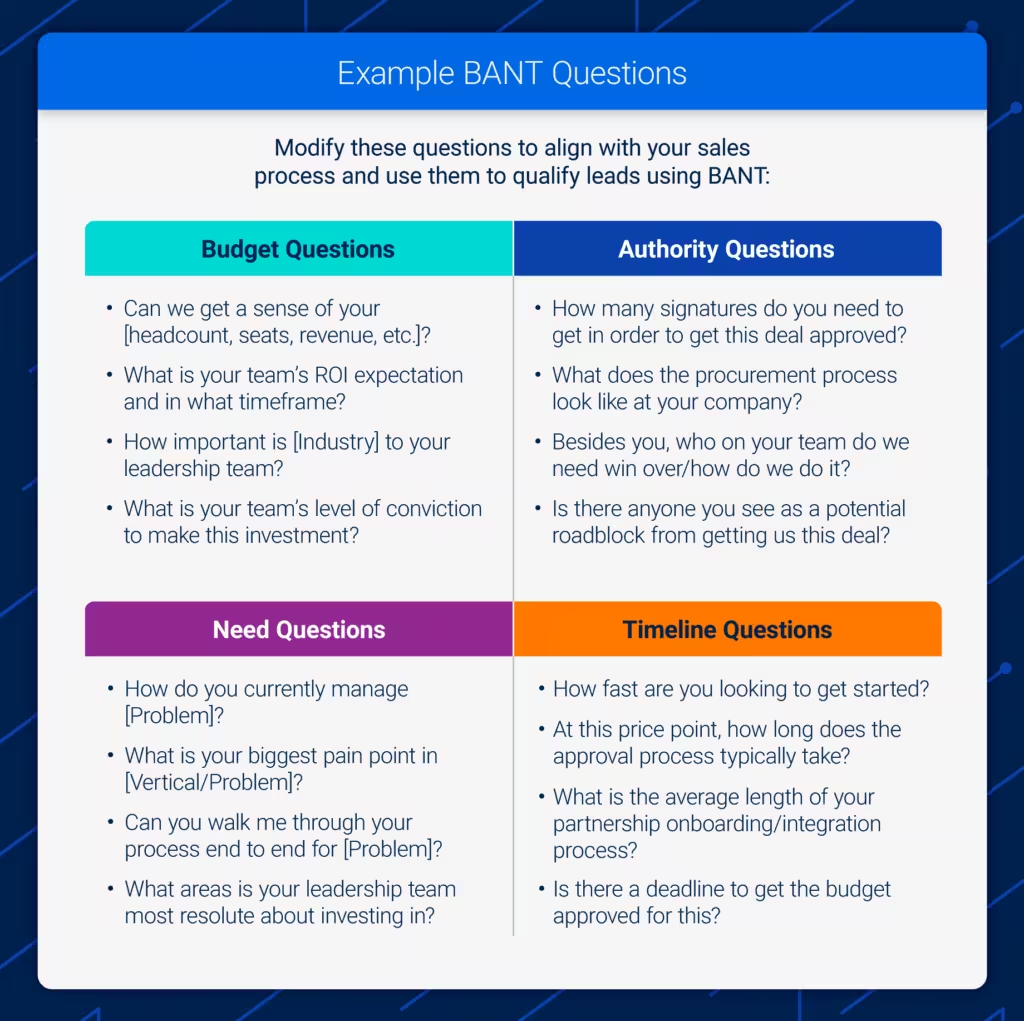
Use the following example questions as a template for a BANT qualification process: not as scripts to ask leads verbatim, but as general guidelines for moving the conversation in the desired direction.
Budget Questions
- Can we get a sense of your [headcount, seats, revenue, etc.]?
- What is your team's ROI expectation and in what timeframe?
- How important is [industry] to your leadership team?
- What is your team's level of conviction to make this investment?
Authority Questions
- How many signatures do you need to get to get this deal approved?
- What does the procurement process look like at your company?
- Besides you, who on your end do we need to convince and how can we win them over?
- Is there anyone you see being a potential roadblock to getting us to the finish line?
Need Questions
- How do you currently manage [problem]?
- What is your biggest pain point in [vertical/problem]?
- Can you walk me through your process end to end for [problem]?
- What areas is your leadership team most resolute about investing in?
Timeline Questions
- How fast are you looking to get started?
- At this price point, how long does the approval process typically take?
- What is the average length of your partnership onboarding/integration process?
- Is there a deadline to get the budget approved for this?
Tracking answers to these questions across every deal is where BANT often breaks down. Reps ask the right things, but the answers live in call notes, not Salesforce. That's the gap Backstory Sheets helps close, flagging deals where BANT criteria are missing before they stall in the pipeline.
Getting to Qualified and Closed-Won Faster
"Sales qualified" is an important distinction and status for leads to be categorized accurately. One way this can be accomplished is by using technology built to distinguish the signal from the noise in your sales activity data.
Instead of spending hours digging through Salesforce to update contacts, records, and accounts, Backstory Sheets lets you update Salesforce like a spreadsheet, freeing up more time for qualifying leads and tracking your team's progress through the sales cycle. Stop drowning in a sea of tabs. Backstory Sheets puts everything you need to see, update, and know in a single view.
Have alignment with AEs and full visibility of the real-time status of current pipeline to track deals as they move towards closed-won.

Related Insights
Explore more expert insights on AI adoption, sales execution, and revenue intelligence to help your team close more deals with confidence.






See Backstory in action,
no meeting required
See the platform for yourself, or get the guide to help you evaluate it.