

Relationships are at the heart of every closed deal, but keeping a pulse on how everyone involved is connected is difficult to do by hand. That's where relationship mapping software comes in.
A relationship mapping tool visualizes every decision maker in a deal: their role, influence, and connections to each other. Sales teams see the entire buyer group at a glance instead of guessing who actually calls the shots. Unlike a static org chart, a good relationship mapping tool updates itself automatically as stakeholders join, leave, or shift influence throughout the deal.
Sales teams use relationship mapping software for key accounts to avoid losing deals, grow revenue among existing accounts, and generate new leads.
What Is a Business Relationship Mapping Tool?
In short, a business relationship mapping tool is a strategic exercise, now automated by AI, that goes well beyond a traditional org chart by surfacing stakeholder roles, influence, hierarchy, and conflict for every account your team is selling into.
Relationship Mapping vs. Org Charts: What's the Difference?
The core difference comes down to what each shows you: software relationship mapping surfaces the human dynamics (motivations, biases, and alliances) that a traditional org chart never captures.
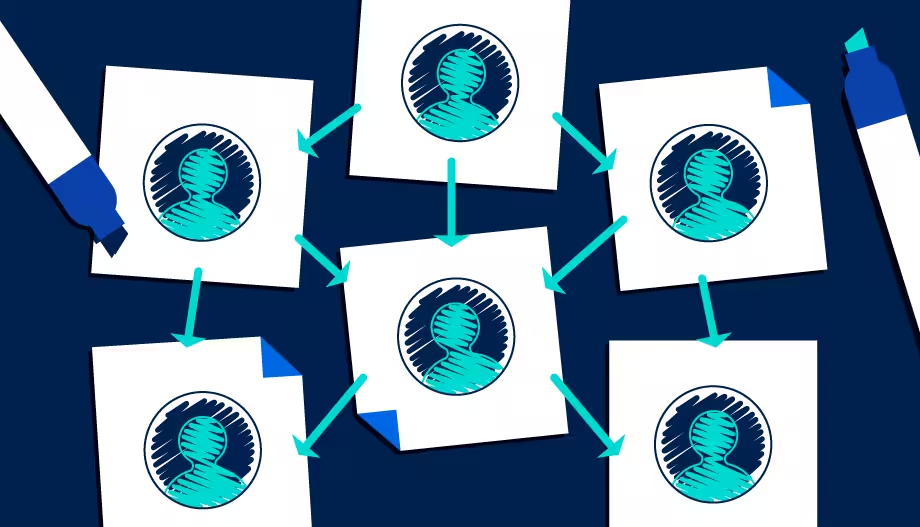
Relationship maps are generated using AI and fueled by tons of relevant sales data. They feature cards for each of the key decision makers in a buyer group that includes details on their role, motivations, challenges, and even biases. These cards are then mapped out to show how each of the stakeholders interacts with each other.
Common roles may include influencers, users, leaders, decision makers, and budget owners, and each comes with their own set of unique motivations and challenges. It is also helpful to highlight who is a supporter, detractor, and champion for your sales team within the account's organization, as well as the strength of the relationship between your team and the individual.
A traditional org chart, on the other hand, helps visualize the hierarchy and size of the company. The org chart can help identify how decisions are made (centralized vs decentralized) but it doesn't map out the decision-making factors that are influenced by the relationships up and down the chain of command.
Why a Manual Mapping Relationships Tool Falls Short
A mapping relationships tool built on manual entry can't keep pace with a buyer group that changes weekly. New stakeholders join, champions go quiet, and the map is stale before it's finished.
While the result can significantly improve close rates and overall relationships with your accounts' key stakeholders, traditional methods for building relationship maps are time consuming. Beyond just the complexities of gathering data to create the relationship map, the challenge of keeping it up to date also makes them difficult to adopt among sales teams.
Fortunately, automation has eliminated the need to manually create and update relationship maps. Let's discuss the key benefits of relationship mapping powered by AI to motivate your organization to adopt this strategic exercise.
How Relationship Mapping Helps Your Sales Team
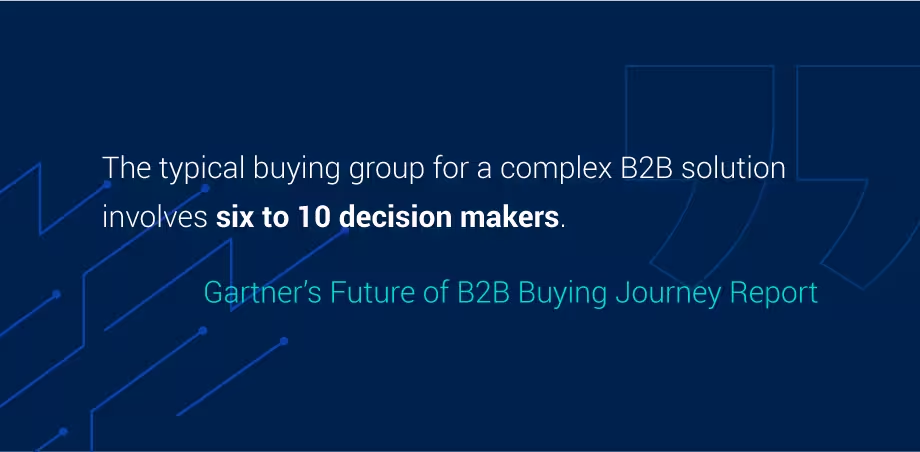
According to research from Gartner, the typical buyer group for complex B2B sales can range from six to 10 decision makers. The best org chart software helps your sales reps keep track of the deal champions (and detractors) within the organization's buyer group.
Along with managers, reps can now strategize accordingly based on each stakeholder's motivations and barriers. For large or complex buyer groups, these maps are especially useful.
There are a few common scenarios where a relationship map will benefit your sales team: closing new deals, upselling or renewing existing accounts, and generating new leads.
Avoid Losing Deals That Rely on One Decision Maker
With buyer groups being composed of so many decision makers, it's important to avoid single-threaded relationships and instead implement multi-threaded relationships within your sales cycle.
In fact, each additional stakeholder brought into a deal was discovered to linearly increase that deal's win rate by 4.5%.
A single-threaded relationship can be detrimental to closing deals for a variety of reasons: the contact leaves their company, moves into a different role, or simply goes cold on you.
Often, these single-threaded relationships happen because your reps do not have the time or resources to map out other stakeholders and nurture multi-threaded relationships. This is where automated relationship mapping with org chart software platforms like Backstory is a huge benefit.
Grow Revenue Among Existing Accounts
Promoting multi-threaded relationships in your sales process does not end once the deal is closed. It should continue as you nurture existing accounts to grow. When your sales reps understand the organization dynamics, motivations, and challenges of each stakeholder for a single account, they better understand how to cross-sell or upsell additional solutions to that organization.
Using automated relationship maps, companies now have an up-to-date record of all the roles, relationships and restructuring of the stakeholder's team. This gives reps the insights to strategize for expansion or cross-sell opportunities because you already are coming into the deal knowing specifically which buyers are already aligned to you vs ones you may need to win over and/or avoid.
Optimize Deal Review and Account Planning
From a sales manager's perspective, a relationship map is essential for guiding the deal review process as well as account planning. Understanding who on the buyer side is compromising a deal early on in the sales cycle can help you coach your reps to build trust with and convince detractors.
The relationship map also helps you plot a course of action to nurture the relationships in a closed-won deal to improve retention and expand accounts.
How Automated Relationship Mapping Software Is Transforming Relationship Intelligence
Traditionally, it's been a catch-22: many sales teams do not create relationship maps because they get more complex as the number of decision makers increases, even though they become more valuable for exactly those complex buyer groups.
To further compound the challenges of traditional methods for creating relationship maps, the data becomes dated quickly and therefore obsolete unless it can be updated in real time.
But with AI, relationship mapping becomes an automated process. Backstory's Data Foundation aggregates the otherwise useless information stored within your team's inbox to generate CRM contacts and applies a taxonomy for titles, contact information, and other metadata. What's more, the data is constantly updated when new information is available, meaning your contacts will never go stale.
Backstory Relationship Maps is the industry's first automated relationship mapping solution that auto-populates every engaged context, including newly threaded relationships.
.avif)
For sales reps, Backstory.ai Relationship Maps reduces the burden of manual data entry, provides insights into the buyer group, and increases overall productivity. For sales leaders, it increases transparency and visibility into each rep's opportunities to help inform and guide deal reviews and coaching sessions. It's a win-win across your sales team that will help increase win rates.
Ready to learn more? Get a demo.
Related Insights
Explore more expert insights on AI adoption, sales execution, and revenue intelligence to help your team close more deals with confidence.






See Backstory in action,
no meeting required
See the platform for yourself, or get the guide to help you evaluate it.